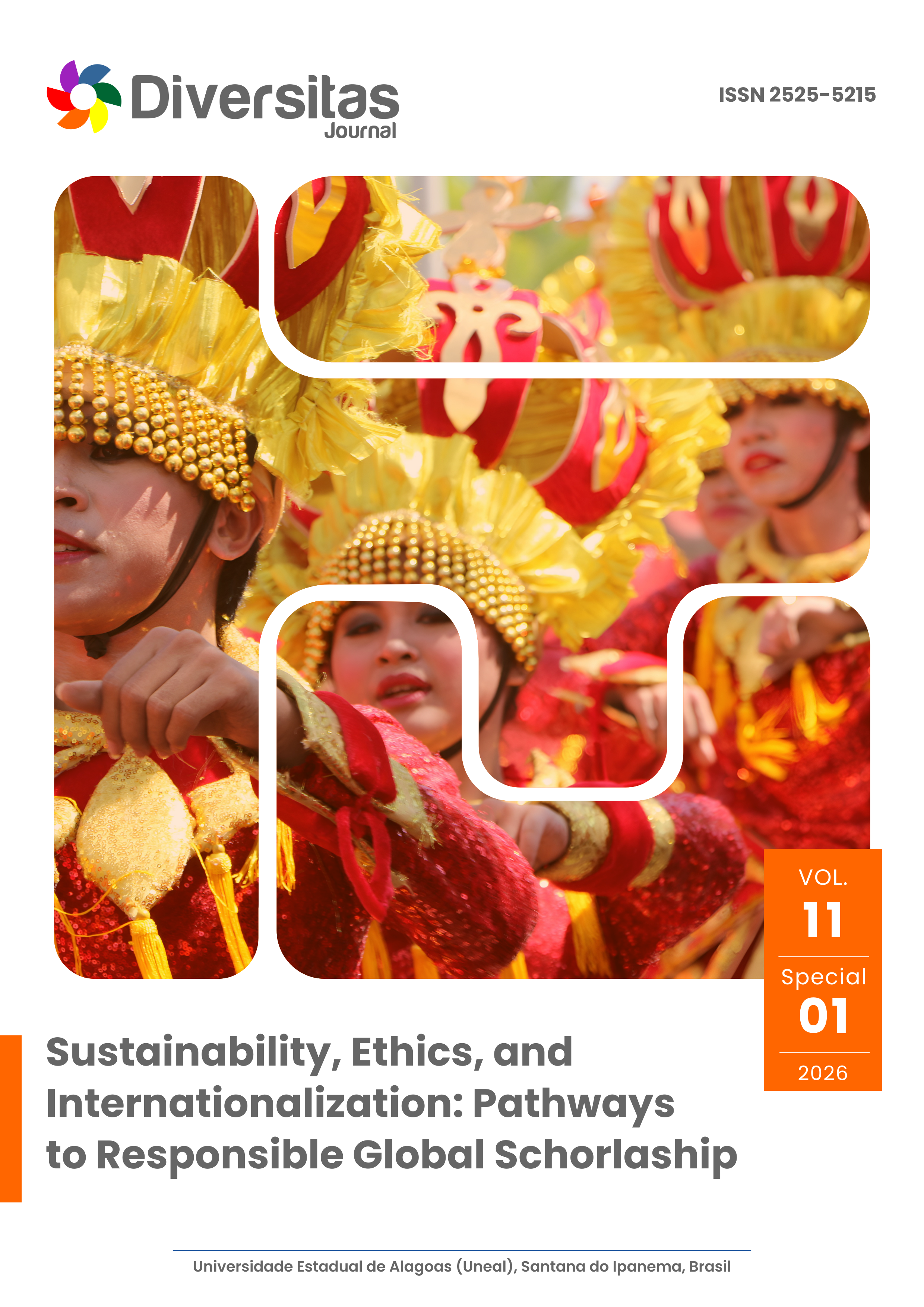
Inícios sociopolíticos fervilhantes do Festival Siomai de Tisa
DOI:
https://doi.org/10.48017/dj.v11iSpecial_1.3630Palavras-chave:
Festival, Edição socio-politicoResumo
Este estudo examinou os fundamentos sociopolíticos e a sustentabilidade do Festival Siomai no bairro de Tisa, na cidade de Cebu, Filipinas. Especificamente, buscou traçar a origem do festival e analisar seu papel na manutenção da identidade local e no engajamento comunitário. Utilizando uma abordagem etnográfica qualitativa, os dados foram coletados por meio de entrevistas e observações com 15 informantes, incluindo autoridades do bairro, vendedores de siomai e turistas locais. A análise temática revelou que o festival surgiu como uma iniciativa sociopolítica estratégica para estabelecer uma identidade local distinta e combater a identificação territorial equivocada com áreas vizinhas. Além disso, a sustentabilidade do festival está ancorada em suas atividades adaptáveis e centradas na comunidade, que promovem a participação, as oportunidades econômicas e o orgulho cultural. O estudo conclui que o Festival Siomai funciona como um instrumento cultural e político que fortalece a coesão comunitária e a imagem local. Recomenda-se que as unidades governamentais locais institucionalizem iniciativas semelhantes, com forte base cultural, para promover o desenvolvimento comunitário sustentável e o turismo gastronômico.
Referências
Haysom, G. (2015, September). Food and the city: Urban scale food system governance. In Urban Forum (Vol. 26, No. 3, pp. 263-281). Dordrecht: Springer Netherlands.
Punzalan, M. E., Ramos, S., Reyes, R., & Barcelon, E. (2013). Consumer perception on safety and sensory evaluation of street-vended pork Dim Sum (Siomai). Asian Journal of Food and Agro-Industry, 6(6), 290-295.
Siomai sa Tisa in Cebu City. (2014, November 10). Blogspot.com. https://flavoursofiloilo.blogspot.com/2014/11/siomai-sa-tisa-in-cebu-city.html
Gonzales, V. D. (2017). Cultural and economic benefits of festivals to community residents of Batangas, Philippines. Asia Pac. J. Educ. Arts Sci, 4, 14-22.
Magpantay, J. H., Decena, K. J. C., de Torres, D. M. M., Garcia, M. J. K. R., Villalobos, A. J. S., Felicen, S. S., & Dinglasan, K. (2014). Socio-cultural effects of festivals in Batangas Province, Philippines. Asia Pacific Journal of Education, Arts and Sciences, 1(4), 1-7.
Mesana, J. C. B., & De Guzman, A. B. (2022). Happiology in community festivals: A case of Filipino repeat local participants. Leisure Studies, 41(1), 129-145.
Del Rosario, P. J. B. (2022). Significance of the Carabaos in Harvest Festivals in the Philippines. In Tourism in the Philippines: Communities, Hosts and Guests (pp. 113-127). Singapore: Springer Nature Singapore.
Peterson, W. (2020). Dancing, marching and baton twirling with the Virgin: Performing community at the Peñafrancia festival in the Philippines. Australasian Drama Studies, (76), 24-61.
Besmonte, P., Candelario, J. P., Colanggoy, K. P., Laroza, L., Villarmea, C. R., & Paul Vincent SD Quinto, L. P. T. (2019). A Feasibility Study on the Healthy Siomai (Vegetable Siomai) at Novaliches Bayan. Ascendens Asia Singapore–Bestlink College of the Philippines Journal of Multidisciplinary Research, 1(1).
Fernandez, D. G. (2019). Food in Philippine History. In Tikim: Essays on Philippine Food and Culture (pp. 137-177). Brill.
Fernandez, D. G. (1988). Culture ingested: Notes on the indigenization of Philippine food. Philippine Studies, 219-232.
See, C. A. (2012). Acculturation, Localization and Chinese Foodways in the Philippines. Chinese Food and Foodways in Southeast Asia and Beyond, 124.
Cabasag, M. A., Batan, B. L., Canonigo, J. T. S., & Inocian, R. B. (2021). The culture and economic attributes of puso street food industry: Basis for a contextualized framework of puso teaching model. Journal of Research, Policy & Practice of Teachers and Teacher Education, 11(1), 63-79.
Alonso, N. (2009, February 23). Cebuano Heritage Cuisine. Philstar.com; Philstar.com.
Downloads
Publicado
Como Citar
Edição
Seção
Licença
Copyright (c) 2026 Louiechi Von Mendoza

Este trabalho está licenciado sob uma licença Creative Commons Attribution 4.0 International License.
O periodico Diversitas Journal expressa que os artigos são de unica responsabilidade dos Autores, conhecedores da legislação Brasileira e internacional. Os artigos são revisados pelos pares e devem ter o cuidado de avisar da possível incidencia de plagiarismo. Contudo o plagio é uma ação incontestavel dos autores. A Diversitas Journal não publicará artigos com indicios de Plagiarismos. Artigos com plagios serão tratados em conformidade com os procedimentos de plagiarismo COPE.
A violação dos direitos autorais constitui crime, previsto no artigo 184, do Código Penal Brasileiro:
“Art. 184 Violar direitos de autor e os que lhe são conexos: Pena – detenção, de 3 (três) meses a 1 (um) ano, ou multa. § 1o Se a violação consistir em reprodução total ou parcial, com intuito de lucro direto ou indireto, por qualquer meio ou processo, de obra intelectual, interpretação, execução ou fonograma, sem autorização expressa do autor, do artista intérprete ou executante, do produtor, conforme o caso, ou de quem os represente: Pena – reclusão, de 2 (dois) a 4 (quatro) anos, e multa.”