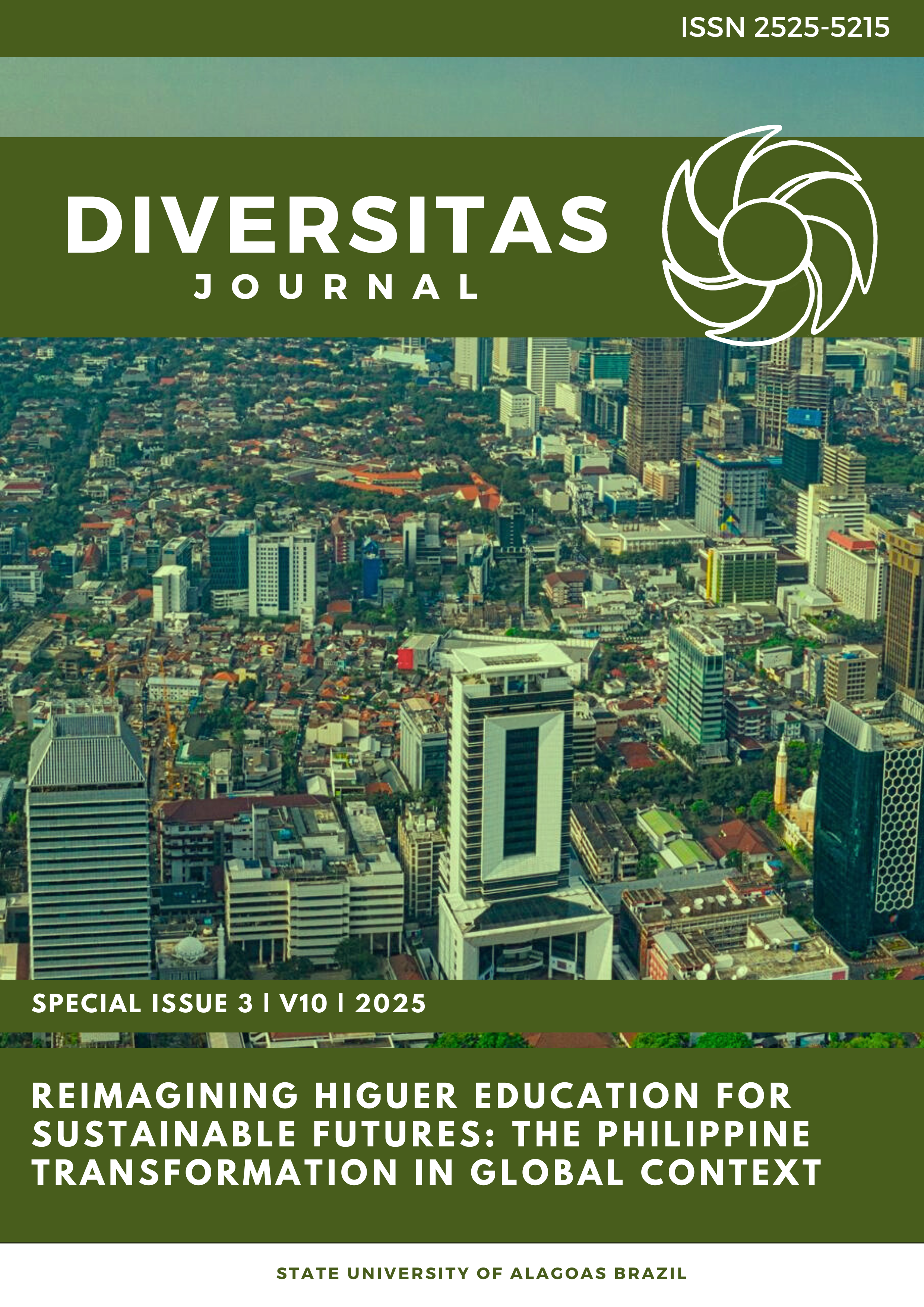
Perspectivas de estudiantes de estudios sociales sobre el uso de Facebook en la celebración de eventos históricos.
DOI:
https://doi.org/10.48017/dj.v10iSpecial_3.3637Palabras clave:
Redes sociales, comemoración, eventos historicos, educación en estudios sociales, facebookResumen
En esta era de la información y la digitalización, las redes sociales se han convertido en los principales medios de comunicación en la educación. Como la red social más grande del mundo, Facebook ha evolucionado de una mera plataforma de comunicación a una herramienta educativa que facilita el discurso académico, el intercambio de contenido y la difusión sin esfuerzo de información, incluyendo información con importancia histórica. Por lo tanto, este estudio descriptivo cualitativo busca describir las perspectivas de los estudiantes de estudios sociales sobre el uso de Facebook, su papel, sus ventajas y desventajas en comparación con el método convencional, y su uso responsable en la conmemoración de eventos históricos. Los entrevistados fueron seleccionados de manera intencional y conveniente. Se realizó una entrevista no estructurada basada en una guía de entrevistas desarrollada por el investigador para recopilar los datos necesarios. Después del análisis de contenido y contexto de los datos, los resultados revelan que los estudiantes de estudios sociales tienen perspectivas ambivalentes sobre el uso de Facebook, generalmente viéndolo como una plataforma prometedora pero defectuosa, especialmente para compartir información y conmemorar eventos históricos. Para ellos, Facebook es innegablemente conveniente y accesible; Sin embargo, cuestionan la fiabilidad y precisión de la plataforma al tratar con contenido histórico, lo que enfatiza aún más la necesidad de verificar los datos con la ayuda de otras fuentes, como materiales impresos e historias orales. Por lo tanto, estudios futuros podrían analizar las implicaciones y repercusiones económicas, socioculturales, educativas y políticas de la plataforma.
Citas
Aiyer, S. J. (2018). Identifying Historical Primary Sources in Social Media for Reliable Historical Reconstruction. In Extended Abstracts of the 2018 CHI Conference on Human Factors in Computing Systems (CHI EA 'EA'18'18). Association for Computing Machinery, 1–6. https://doi.org/10.1145/3170427.3180283.
Apuke, O.D. (2017). Social and Traditional Mainstream Media of Communication: Synergy and Variance Perspective. Online Journal of Communication and Media Technologies, 7(4), pp. 132-140. https://doi.org/10.29333/ojcmt/2614.
Ayton, D. (2023). Chapter 5: Qualitative Descriptive Research. Open Educational Resources Collective*. https://oercollective.caul.edu.au/qualitative-research/chapter/__unknown__-5/
Baek, K., Holton, A., Harp, D., & Yaschur, C. (2011). The links that bind: Uncovering novel motivations for linking on Facebook. Computers in Human Behavior, 27(6), pp. 2243-2248. https://doi.org/10.1016/j.chb.2011.07.003.
Bernal, P. (2018). Fakebook: why Facebook makes the fake news problem inevitable. Northern Ireland Legal Quarterly, 69(4). https://doi.org/10.53386/nilq.v69i4.182.
Bingham, A.J. (2023). From Data Management to Actionable Findings: A Five-Phase Process of Qualitative Data Analysis. International Journal of Qualitative Methods, 22. https://doi.org/10.1177/16094069231183620.
Blaha, C. E. (2013). Facebook forever : Privacy, preservation, and Social Networking Records [Texas School Works, The University of Texas at Austin]. University of Texas Libraries. https://repositories.lib.utexas.edu/items/0b95c6d0-27c5-4f53-9481-fc83f610f515.
Brey, P. (2017). The strategic role of technology in a good society. Technology in Society, 52, 39-45. https://doi.org/10.1016/j.techsoc.2017.02.002.
Brown, V. & Vaughn, E.D. (2011). The Writing on the (Facebook) Wall: The Use of Social Networking Sites in Hiring Decisions. Journal of Business and Psychology, 26, 219-225. https://doi.org/10.1007/S10869-011-9221-X.
Buffington, M.L. (2008). What is Web 2.0, and How Can it Further Art Education? Art Education, 61, 36 - 41. https://doi.org/10.1080/00043125.2008.11652058.
Cohen, D.J. & Rosenzweig, R. (n.d.). Promises and Perils of Digital History. Digital History*. https://chnm.gmu.edu/digitalhistory/introduction/
DataReportal. (2025 March 12). Facebook users, stats, data & trends for 2025. DataReportal*. https://datareportal.com/essential-facebook-stats?utm_source=DataReportal&utm_medium=Country_Article_Hyperlink&utm_campaign=Digital_2025&utm_term=Philippines&utm_content=Facebook_Stats_Link.
Davis, J.L. (2016). Social Media. Wiley Online Library. https://doi.org/10.1002/9781118541555.wbiepc004.
Dijck, J. (2012). Facebook and the engineering of connectivity: A multi-layered approach to social media platforms. Convergence: The International Journal of Research into New Media Technologies, 19(2), 141-155. https://doi.org/10.1177/1354856512457548.
Dobrowsky, D. (2012). Constructing identity on social networks. An analysis of the competencies of communication on Facebook.com. Central and Eastern European Online Library*, 8, 91-103. https://www.ceeol.com/search/article-detail?id=105553.
Elena-Iulia, V. (2018). The importance of social media. [Annals - Economy Series, Constantin Brancusi University, Faculty of Economics]. Ideas. https://ideas.repec.org/a/cbu/jrnlec/y2018v6p80-91.html.
Filippelli, R. (1976). Oral History and the Archives. American Archivist, 39(4), 479-483. https://doi.org/10.17723/AARC.39.4.U3KW876J8127WL55.
Frary, M. (2018). Checking the history bubble: Historians will have to use social media as an essential tool in future research. How will they decide if its information is unreliable or wrong?. Index on Censorship, 47(1). https://doi.org/10.1177/0306422018770123.
Glenski, M., Volkova, S., & Kumar, S. (2020). User Engagement with Digital Deception. In: Shu, K., Wang, S., Lee, D., Liu, H. (eds) Disinformation, Misinformation, and Fake News in Social Media. Lecture Notes in Social Networks. Springer, 39-61. https://doi.org/10.1007/978-3-030-42699-6_3.
Hennink, M. & Kaiser, B. (2021). Sample sizes for saturation in qualitative research: A systematic review of empirical tests. Social Science & Medicine, 292. https://doi.org/10.1016/j.socscimed.2021.114523.
Hou, J. & Kankham, S. (2023). Follow and spread the word: the effects of avatars and message framing in promoting fact-checking on social media. Information Technology & People, 37(4), 1717-1752. https://doi.org/10.1108/itp-10-2022-0793.
Hilary, I.O. & Dumebi, O. (2021). Social Media as a Tool for Misinformation and Disinformation Management. Linguistics and Culture Review. https://doi.org/10.21744/lingcure.v5ns1.1435.
Idris, Y. & Wang, Q. (2009). Affordances of Facebook for learning. International Journal of Continuing Engineering Education and LifeLifelongrning, 19(2-3), 247-255. https://doi.org/10.1504/IJCEELL.2009.025031.
Jain, A. (2023). The Dark Side of Social Media: How Online Platforms Enable the Spread of Misinformation and Conspiracy Theories. Journal of Communication and Management, 2(4). https://doi.org/10.58966/jcm2023241.
Jumaat, N., Ahmad, N., Samah, N.A., Ashari, Z.M., Ali, D.F., & Abdullah, A.H. (2019). Facebook is a Platform of Social Interactions for Meaningful Learning. International Journal of Emerging Technologies in Learning, 14(4), 151-159. https://doi.org/10.3991/IJET.V14I04.9363.
Kallio, H., Pietilä, A., Johnson, M., & Kangasniemi, M. (2016). Systematic methodological review: developing a framework for a qualitative semi-structured interview guide. Journal of Advanced Nursing, 72(12), 2954-2965 . htps://doi.org/10.1111/jan.13031.
Kapoor, K. K., Tamilmani, K., Rana, N. P., Patil, P., Dwivedi, Y. K., & Nerur, S. (2017). Advances in Social Media Research: Past, Present, and Future. Information Systems Frontiers, 20, 531-558. https://doi.org/10.1007/S10796-017-9810-Y.
Kelpšienė, I., Armakauskaitė, D., Denisenko, V., Kirtiklis, K., Laužikas, R., Stonytė, R., Murinienė, L., & Dallas, C. (2022). Difficult heritage on social network sites: An integrative review. New Media & Society, 25(11), 3137–3164. https://doi.org/10.1177/14614448221122186.
Liang, X., Lu, Y., & Martin, J. (2020). A Review of the Role of Social Media for Cultural Heritage Sustainability. Preprints, 13, 1055. https://doi.org/10.20944/preprints202012.0618.v1.
Liu, S.B. (2011). Digital commemoration: surveying the social media revival of historical crises. Association for Computing Machinery, 947-952. https://doi.org/10.1145/1979742.1979521.
Manovich, L., Tīfentāle, A., Yazdani, M., & Chow, J. (2014). The exceptional and the everyday: 144 Hours in Kyiv. 2014 IEEE International Conference on Big Data (Big Data), 72-79. https://doi.org/10.1109/BigData.2014.7004456.
Meta Platforms, Inc. (2023, October 25). Meta reports third quarter 2023 results. PR Newswire*. https://www.prnewswire.com/news-releases/meta-reports-third-quarter-2023-results-301967878.html
Modern History (1966). Nature, 210, 575. https://doi.org/10.1038/210575b0.
Moss, W. (1977). Oral History: An Appreciation. American Archivist, 40(4), 429-439. https://doi.org/10.17723/AARC.40.4.Y10Q27J415278520.
Narwal, B. (2018). Fake News in Digital Media. 2018 International Conference on Advances in Computing, Communication Control and Networking (ICACCCN), 977-981. https://doi.org/10.1109/ICACCCN.2018.8748586.
Nosko, A., Wood, E., & Molema, S. (2010). All about me: Disclosure in online social networking profiles: The case of FACEBOOK. Computers in Human Behavior, 26(3), 406-418. https://doi.org/10.1016/j.chb.2009.11.012.
Oladipo, T. (2025, May 21). 20+ top social media sites to consider for your brand. Buffer*. https://buffer.com/library/social-media-sites/#:~:text=Facebook%20is%20the%20largest%20social,931%20million%20monthly%20active%20users.
Ortiz-Ospina, E. (2019). The rise of social media. Our World In Data*. https://ourworldindata.org/rise-of-social-media.
Patil, S., Vairagade, S., & Theng, D. (2021). Machine Learning Techniques for the Classification of Fake News. 2021 International Conference on Computational Intelligence and Computing Applications (ICCICA), 1-5. https://doi.org/10.1109/iccica52458.2021.9697267.
Porter, E. & Wood, T. (2022). Political Misinformation and Factual Corrections on the Facebook News Feed: Experimental Evidence. The Journal of Politics, 84(3), 1812 - 1817. https://doi.org/10.1086/719271.
Poza, E., & Jódar, L. (2019). Modeling Human Behaviour in the Digital Era: Economic and Social Impacts. ECONOMICS, 7, 43 - 47. https://doi.org/10.2478/eoik-2019-0015.
Prijanto, J.H. (2022). Social Studies - Historical Learning System for Gen Z in the New Normal Era. Progres Pendidikan, 3(2). https://doi.org/10.29303/prospek.v3i2.238.
Roseveare, C. (2023). Thematic Analysis: A Practical Guide, by Virginia Braun and Victoria Clarke. Canadian Journal of Program Evaluation, 38(1). https://doi.org/10.3138/cjpe.76737.
Rowe, J. (2014). Student use of social media: when should the university intervene?. Journal of Higher Education Policy and Management, 36(3), 241 - 256. https://doi.org/10.1080/01587919.2014.899054.
Robards, B., Lincoln, S., Pinkard, B., & Harris, J. I. (2018). Remembering through Facebook: Mediated memory and intimate digital traces. In Palgrave studies in communication for social change, 75–91. https://doi.org/10.1007/978-3-319-97607-5_5.
Saito, H. (2010). From Collective Memory to Commemoration. Handbook of Cultural Sociology, pp. 629-638. https://ink.library.smu.edu.sg/soss_research/1897
Samantha, K., & Majhi, S. C. (2023). Conservation and Preservation of Manuscripts in the Nazrul Academy Town Library: A Study and Proposal for their Modernization. Library Philosophy and Practice, 7542. https://digitalcommons.unl.edu/libphilprac/7542.
Sedlacik, M. (2015). Social Media and Heritage Preservation. Present Pasts, 6(1), 60. https://doi.org/10.5334/pp.60.
Selwyn, N. (2009). Faceworking: exploring students’ education‐related use of Facebook. Learning, Media and Technology, 34(2), 157–174. https://doi.org/10.1080/17439880902923622.
Shahjahan, A.T.M. & Chisty, K. U. (2014). Social Media Research and Its Effect on Our Society. International Journal of Information and Communication Engineering, 8(6), 2009-2013. https://publications.waset.org/9998891/social-media-research-and-its-effect-on-our-society.
Sierp, A. (2025). The Politics of Memory: Between History, Identity and Conflict. Government and Opposition, 60(4), 1464-1483. https://doi.org/10.1017/gov.2025.10011.
Singh, A., & Ahmad, T. (2022). Examining the Impact of Social Media on Youth and Its Future for History Learning. Paramita Historical Studies Journal, 32(2), 253-262. https://doi.org/10.15294/paramita.v32i2.35055
Stock, M. (2017). HCI Research and History: Special Interests on Facebook as Historical Sources. In: Stephanidis, C. (eds) HCI International 2017 – Posters' Extended Abstracts. HCI 2017. Communications in Computer and Information Science. Springer, 497-503. https://doi.org/10.1007/978-3-319-58750-9_69.
Thomson, S.D. & Kilbride, W. (2015). Preserving Social Media: The Problem of Access. New Review of Information Networking, 20(1-2), 261 - 275. https://doi.org/10.1080/13614576.2015.1114842.
Trautschold, M., Mazo, G., & Karch, M. (2010). Social Media and Skype. In: DROIDS Made Simple. Springer, 409-436. https://doi.org/10.1007/978-1-4302-3280-3_22
Wang, R., Scown, P., Urquhart, C., & Hardman, J. (2014). Tapping the educational potential of Facebook: Guidelines for use in higher education. Education and Information Technologies, 19, 21-39. https://doi.org/10.1007/s10639-012-9206-z.
Ward, C.W. (2011). Documenting New York: Identifying and Saving New York's Primary Sources. The Public Historian, 33(3), 99-115. https://doi.org/10.1525/TPH.2011.33.3.99.
Weisman, B.R. (2020). Oral Sources and Oral History. In: Smith, C. (eds) Encyclopedia of Global Archaeology. Springer, 8113-8119. https://doi.org/10.1007/978-3-030-30018-0_1401
West, F. (1966). [Review of Oral Tradition. A Study in Historical Methodology, by J. Vansina & H. M. Wright]. History and Theory, 5(3), 348–352. https://doi.org/10.2307/2504454.
Wilmsen, C. (2019). For the Record: Editing and the Production of Meaning in Oral History. The Oral History Review, 28, 65 - 85. https://doi.org/10.1525/ohr.2001.28.1.65.
Wilson, R., Gosling, S.D., & Graham, L.T. (2012). A Review of Facebook Research in the Social Sciences. Perspectives on Psychological Science, 7(3), 203 - 220. https://doi.org/10.1177/1745691612442904.
Wineburg, S., McGrew, S., Breakstone, J., & Ortega, T. (2020). Evaluating information: The cornerstone of civic online reasoning. Stanford Digital Repository. https://purl.stanford.edu/fv751yt5934
Zhao, Y., Da, J., & Yan, J. (2021). Detecting health misinformation in online health communities: incorporating behavioral features into machine learning based approaches. Information Processing & Management, 58(1). https://doi.org/10.1016/j.ipm.2020.102390.
Descargas
Publicado
Cómo citar
Número
Sección
Licencia
Derechos de autor 2025 Ralph Eufranz Cane, Trisha Mae Arriesgado, Geremie Generale, Reynaldo Inocian, Joseph Sol Galleon

Esta obra está bajo una licencia internacional Creative Commons Atribución 4.0.
O periodico Diversitas Journal expressa que os artigos são de unica responsabilidade dos Autores, conhecedores da legislação Brasileira e internacional. Os artigos são revisados pelos pares e devem ter o cuidado de avisar da possível incidencia de plagiarismo. Contudo o plagio é uma ação incontestavel dos autores. A Diversitas Journal não publicará artigos com indicios de Plagiarismos. Artigos com plagios serão tratados em conformidade com os procedimentos de plagiarismo COPE.
A violação dos direitos autorais constitui crime, previsto no artigo 184, do Código Penal Brasileiro:
“Art. 184 Violar direitos de autor e os que lhe são conexos: Pena – detenção, de 3 (três) meses a 1 (um) ano, ou multa. § 1o Se a violação consistir em reprodução total ou parcial, com intuito de lucro direto ou indireto, por qualquer meio ou processo, de obra intelectual, interpretação, execução ou fonograma, sem autorização expressa do autor, do artista intérprete ou executante, do produtor, conforme o caso, ou de quem os represente: Pena – reclusão, de 2 (dois) a 4 (quatro) anos, e multa.”