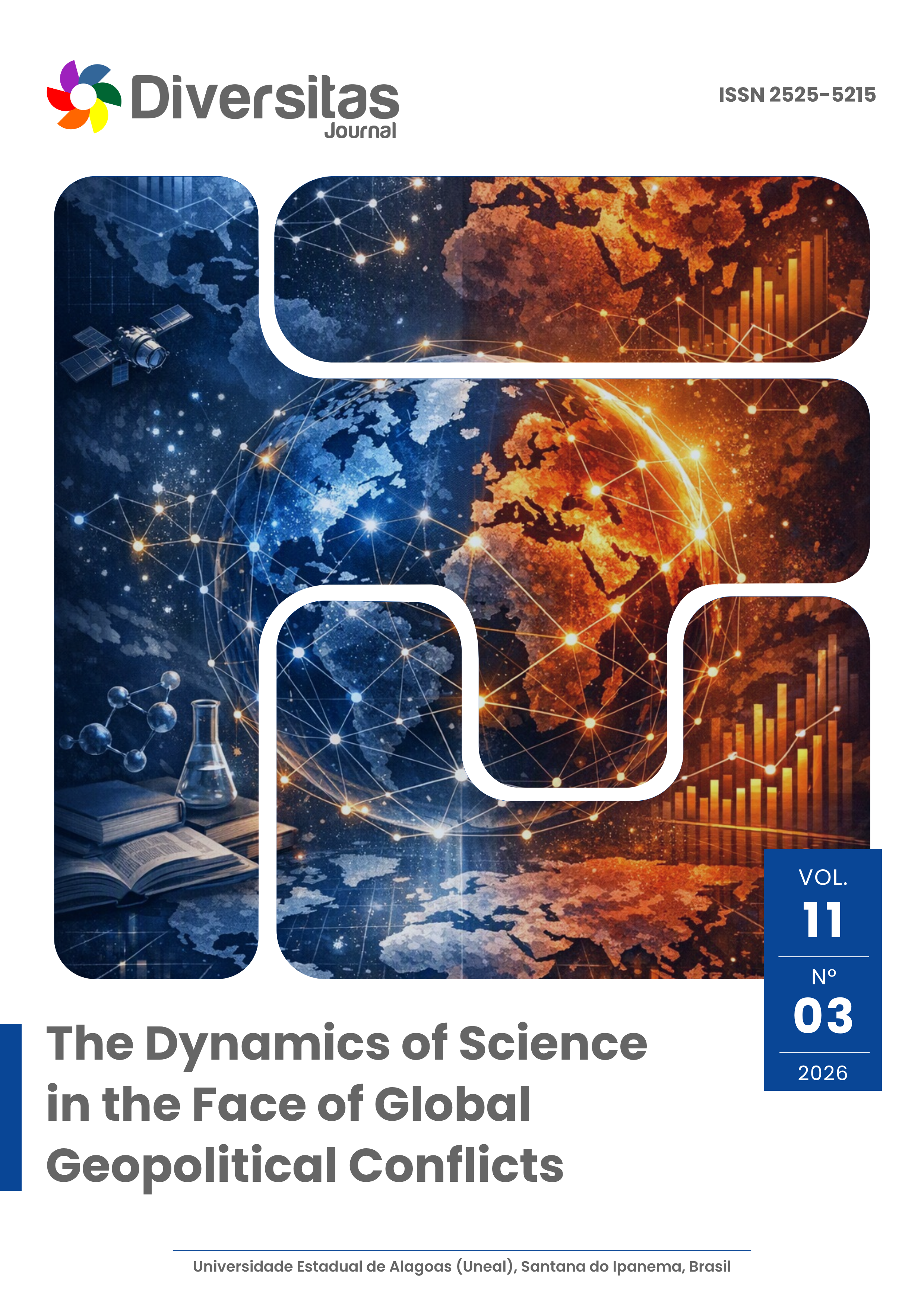
The Dynamics of Science in the Face of Global Geopolitical Conflicts
DOI:
https://doi.org/10.48017/dj.v11i3.4232Keywords:
Science; Global Geopolitics; Territorial Conflicts; Environmental Crisis; Scientific Cooperation; Socio-environmental Justice.Abstract
This editorial from Diversitas Journal discusses the relationship between scientific production and contemporary geopolitical transformations, highlighting how wars, territorial disputes, technological competition, and environmental crises influence the production and circulation of knowledge. Armed conflicts, in addition to causing severe humanitarian consequences, damage ecosystems, destroy scientific institutions, and deepen social and territorial inequalities. In this context, disputes over the control of strategic natural resources, technologies, information, and artificial intelligence demonstrate the central role of science in international power relations. The editorial also addresses the socio-environmental impacts of the energy transition, particularly on Indigenous peoples, traditional communities, and peasant populations, emphasizing that the effects of environmental crises are unevenly distributed. In the face of scientific denialism, funding restrictions, and threats to university autonomy, the editorial reaffirms science as a collective heritage of humanity and advocates intellectual freedom, international cooperation, and an ethical commitment to social and environmental justice. Finally, it emphasizes the importance of interdisciplinary dialogue and epistemological diversity in building knowledge capable of contributing to peace, sustainability, democracy, and human development.
References
Jasanoff, S. (Ed.). (2004). States of knowledge: The co-production of science and the social order. Routledge.
Krenak, A. (2019). Ideias para adiar o fim do mundo. Companhia das Letras.
Latour, B. (2020). Onde aterrar? Como se orientar politicamente no Antropoceno (M. Vieira, Trad.). Bazar do Tempo.
Latour, B. (2019). Políticas da natureza: Como fazer ciência na democracia. Editora Unesp.
Ruffini, P.-B. (2017). Science and diplomacy: A new dimension of international relations. Springer. https://doi.org/10.1007/978-3-319-55104-3
Santos, B. de S. (2014). Epistemologies of the South: Justice against epistemicide. Routledge.
Svampa, M. (2019). Neo-extractivism in Latin America: Socio-environmental conflicts, the territorial turn, and new political narratives. Cambridge University Press. https://doi.org/10.1017/9781108707121
Published
How to Cite
Issue
Section
License
Copyright (c) 2026 Cirlene Jeane Santos e Santos

This work is licensed under a Creative Commons Attribution 4.0 International License.
The Diversitas Journal expresses that the articles are the sole responsibility of the Authors, who are familiar with Brazilian and international legislation.
Articles are peer-reviewed and care should be taken to warn of the possible incidence of plagiarism. However, plagiarism is an indisputable action by the authors.
The violation of copyright is a crime, provided for in article 184 of the Brazilian Penal Code: “Art. 184 Violating copyright and related rights: Penalty - detention, from 3 (three) months to 1 (one) year, or fine. § 1 If the violation consists of total or partial reproduction, for the purpose of direct or indirect profit, by any means or process, of intellectual work, interpretation, performance or phonogram, without the express authorization of the author, the performer, the producer , as the case may be, or whoever represents them: Penalty - imprisonment, from 2 (two) to 4 (four) years, and a fine. ”