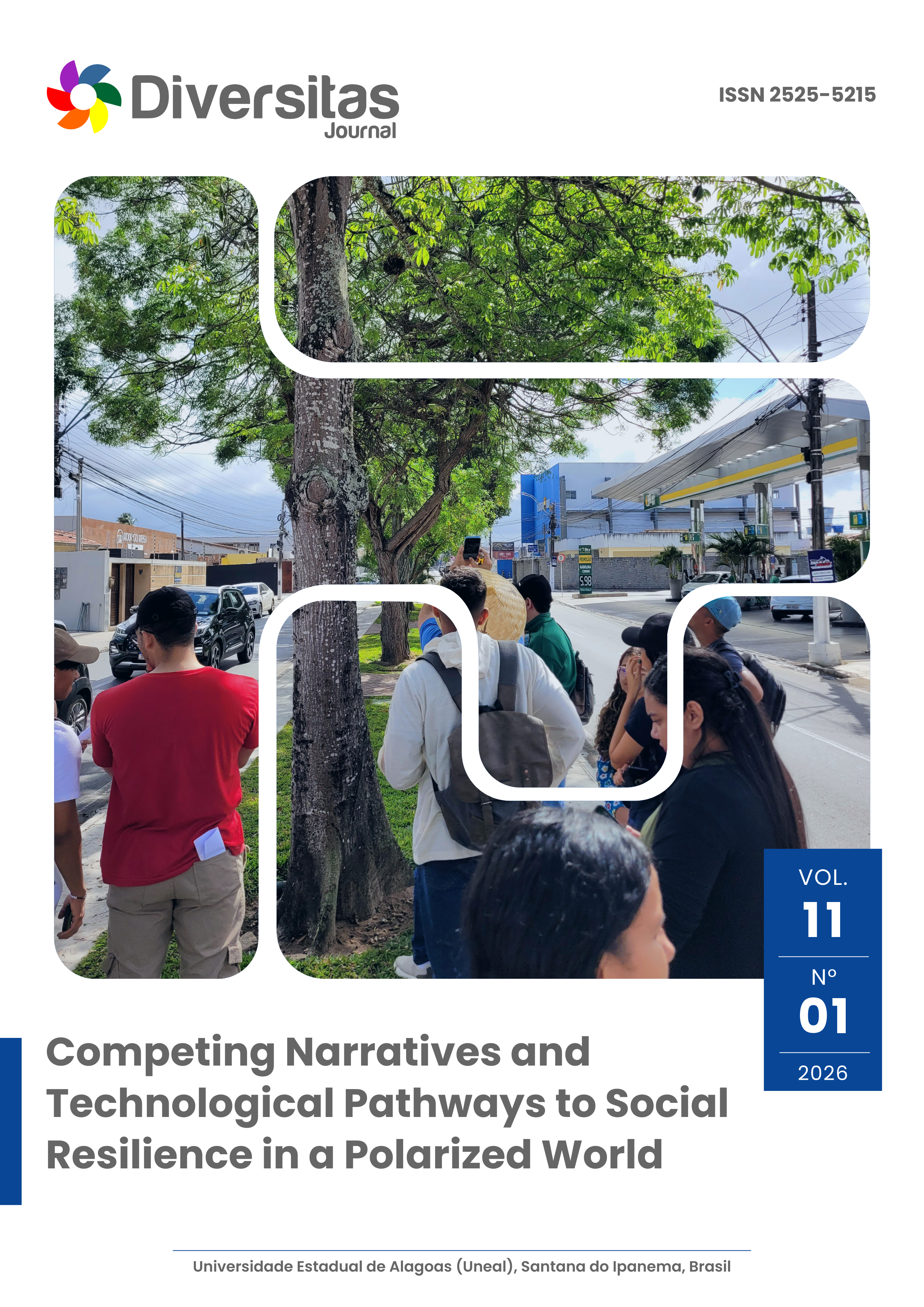
Competing Narratives and Technological Pathways to Social Resilience in a Polarized World
DOI:
https://doi.org/10.48017/dj.v11i1.3856Keywords:
Geopolitical conflicts, technology, misinformation, Social Resilience, Ideological polarizationAbstract
The contemporary global landscape is increasingly defined by geopolitical conflicts, economic instability, and deeply polarized political narratives that transcend national borders. Within this context, in this editorial, I offer some perspectives on technology's dual role, i.e., intensifying polarization through misinformation, algorithmic bias, and computational propaganda, while simultaneously offering powerful tools for mitigation and resilience. The editorial calls for a critical and integrative approach to technological innovation that aligns technological pathways with social resilience, democratic values, and global solidarity in an increasingly unsettled and polarized world.
Metrics
References
de Carvalho, V. D. H., Nepomuceno, T. C. C., Poleto, T., & Costa, A. P. C. S. (2022a). The COVID-19 infodemic on Twitter: A space and time topic analysis of the Brazilian immunization program and public trust. Tropical Medicine and Infectious Disease, 7(12), 425.
de Carvalho, V. D. H., Nepomuceno, T. C. C., Poleto, T., Turet, J. G., & Costa, A. P. C. S. (2022b). Mining public opinions on COVID-19 vaccination: a temporal analysis to support combating misinformation. Tropical Medicine and Infectious Disease, 7(10), 256.
de Queiroz, F. A. F., Negreiros, I. B., de Souza, G., de Sousa, D. C., & Júnior, S. F. A. X. (2024). Predicting Sentiments in Spotify Comments: A Comparative Analysis of Machine Learning Models. Socioeconomic Analytics, 2(1), 107-113.
Rahimian, M. A., & Colaresi, M. P. (2025). Democratic resilience and sociotechnical shocks: MA Rahimian, M. Colaresi. Computational and Mathematical Organization Theory, 1-22.
Nepomuceno, T. C. C., & Costa, A. P. C. S. (2019). Invalid votes, deliberate abstentions, and the Brazilian crisis of representation. Politics & Policy, 47(2), 381-406.
Rød, B., Pursiainen, C., & Eklund, N. (2025). Combatting Disinformation–How Do We Create Resilient Societies? Literature Review and Analytical Framework. European Journal for Security Research, 1-43.
Shahbazi, M., & Bunker, D. (2024). Social media trust: Fighting misinformation in the time of crisis. International Journal of Information Management, 77, 102780.
Downloads
Published
How to Cite
Issue
Section
License
Copyright (c) 2026 Prof. Thyago Nepomuceno

This work is licensed under a Creative Commons Attribution 4.0 International License.
The Diversitas Journal expresses that the articles are the sole responsibility of the Authors, who are familiar with Brazilian and international legislation.
Articles are peer-reviewed and care should be taken to warn of the possible incidence of plagiarism. However, plagiarism is an indisputable action by the authors.
The violation of copyright is a crime, provided for in article 184 of the Brazilian Penal Code: “Art. 184 Violating copyright and related rights: Penalty - detention, from 3 (three) months to 1 (one) year, or fine. § 1 If the violation consists of total or partial reproduction, for the purpose of direct or indirect profit, by any means or process, of intellectual work, interpretation, performance or phonogram, without the express authorization of the author, the performer, the producer , as the case may be, or whoever represents them: Penalty - imprisonment, from 2 (two) to 4 (four) years, and a fine. ”